
Joe
PowersportsList Assistant
Hi, I'm Joe!
Ask me about listings, events, businesses, or how the site works.
Published
March 24, 2026
Reading Time
19 min read
Street riding demands different protection than off-road. While dirt bikes and ATVs deal with lower speeds and more predictable crashes, motorcycle riding on pavement exposes you to high-speed impacts, wind forces, and complex accident scenarios. A helmet designed for trail riding won't adequately protect you at highway speeds, which is why understanding street-specific helmet technology matters.
The motorcycle helmet market in 2026 is experiencing genuine innovation—new safety technologies, advanced materials, integrated electronics, and crash detection systems that actually work. This guide cuts through the marketing to help you choose a helmet that provides real protection while meeting your needs for comfort, visibility, and features.
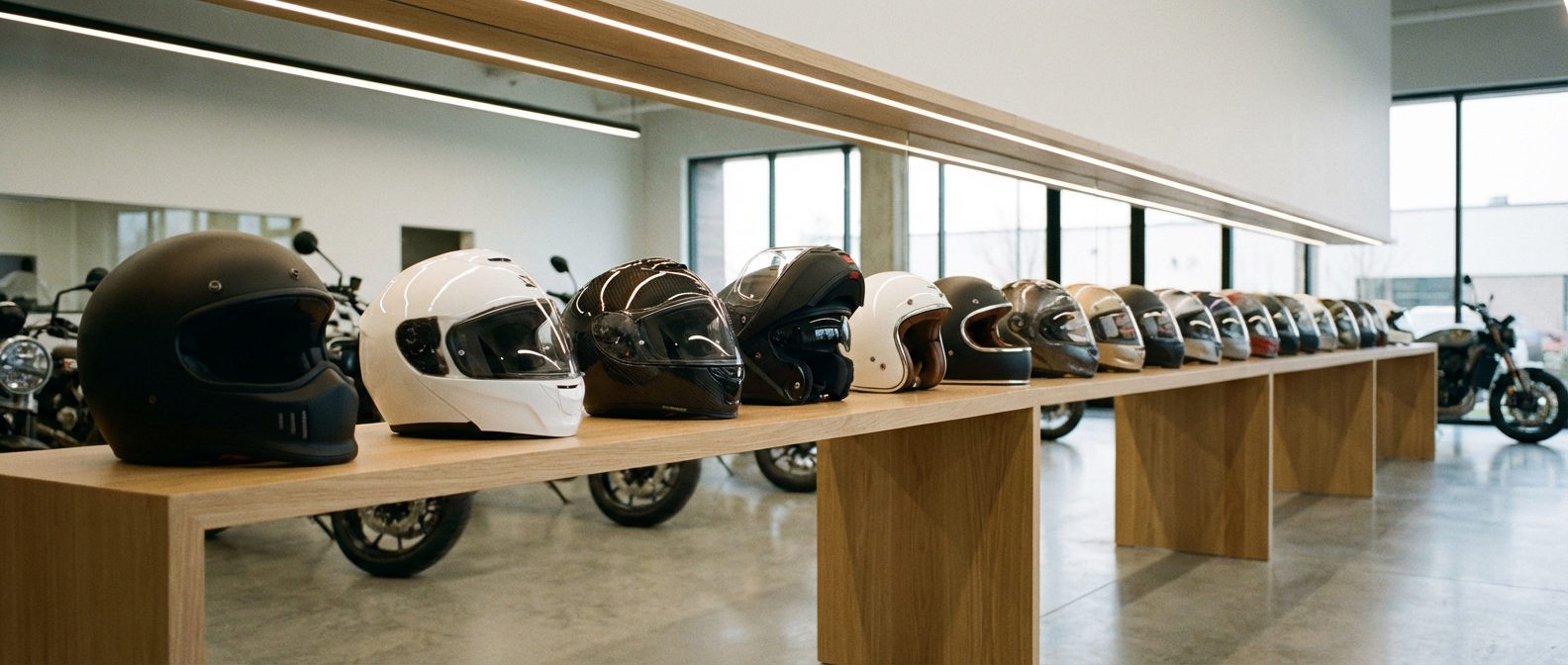
Street helmets come in distinct categories, each with different protection profiles and intended uses. Understanding these categories helps you choose appropriately.
Full-face helmets cover your entire head and face, offering the most comprehensive protection available. The integrated face piece shields your entire face, chin, and jaw—areas that take tremendous impact in street crashes.
Protection characteristics: In a typical motorcycle crash, your face is the first contact point for many impact scenarios. A full-face helmet protects your chin, jaw, nose, and cheekbones—injuries that often determine whether a crash results in scarring, dental work, and facial reconstruction or relatively minor injuries.
Full-face helmets are always the safest choice for street riding. Safety experts universally recommend full-face for any speeds above 30 mph, and realistically, for all street riding.
The downsides are reduced peripheral vision (though modern designs minimize this), less field of view above you, and potential claustrophobia for some riders. However, acclimation happens quickly, and the safety benefits vastly outweigh these minor compromises.
Best for: All street riding. If you ride a motorcycle on pavement, full-face is the correct choice.
Modular helmets feature a chin piece that flips up, allowing you to raise the face protection without removing the helmet. This enables gas station stops, quick conversations, and eating without completely removing your helmet.
The flip-up mechanism adds mechanical complexity and weight compared to dedicated full-face designs. The hinge means the helmet is not quite as rigid as a full-face, and the chin bar mechanism requires maintenance.
Many riders use flip-ups for convenience, flipping up at stops and relying on the helmet's pivot between rides. Full-time flip-up use (riding with the chin bar raised) dramatically reduces protection, as you're essentially wearing an open-face helmet.
Best for: Commuting riders who value convenience at stops, or riders who switch between open and closed protection. Not ideal for sport riding or highway speeds.
Three-quarter helmets (sometimes called open-face) cover the top and back of your head but leave your face, chin, and jaw completely exposed. They offer better visibility and ventilation than full-face designs but significantly less protection.
The unprotected face is a critical vulnerability. In typical crashes, chin and face injuries are common—often severe. Three-quarter helmets protect you from some impacts (hitting a tree limb, debris) but not from the most common serious injuries in street crashes.
These helmets are genuinely only appropriate for slow-speed, low-risk riding. Wearing a three-quarter on a highway is genuinely risky—a lowside at speed leaves your face completely vulnerable.
Best for: Slow-speed cruising, casual neighborhood riding where you're not expecting traffic incidents.
Minimal designs offering the least protection, covering only the top portion of your head. Half helmets protect you from the obvious—hitting overhead obstacles—but leave your entire face, jaw, and temples exposed.
Half helmets are appropriate only for extremely low speeds with minimal crash risk. They're genuinely not suitable for any real street riding where traffic or unexpected incidents could occur.
If you're a serious street rider, the decision is simple: full-face helmets provide the best protection. Sport riders should always wear full-face. Commuters can justify modular helmets for convenience, though full-face is technically safer. Everything else represents compromise you shouldn't accept unless you're riding under very specific low-speed conditions.
The helmet market includes several safety certification standards. Understanding them helps you assess genuine protection levels.
DOT is the legal minimum in the United States. A helmet with a DOT sticker has met minimum US federal standards for impact absorption and retention strength.
DOT testing involves dropping helmets onto anvils and measuring the deceleration transmitted to a test head form. It's effective at identifying obviously inadequate helmets, but it's less rigorous than other standards.
All motorcycle helmets sold in the US should have DOT certification. It's the legal baseline, but it's not the highest standard.
The European ECE standard is more rigorous than DOT and is increasingly the international standard for helmet quality. ECE 22.06 is the current version (22.05 was the previous standard), and testing is more demanding than DOT, including:
Many safety experts prefer ECE certification because the testing is more comprehensive. A helmet with ECE 22.06 is likely safer than a helmet with only DOT certification.
Snell is the gold standard for racing and serious riders. Snell testing is significantly more stringent than both DOT and ECE, involving higher drop heights, multiple impact locations, and more demanding retention requirements.
Snell M2025 is the current standard (valid through 2030), and achieving it requires helmets to exceed both DOT and ECE requirements.
Note: Snell certification doesn't guarantee a better street helmet—it's primarily racing-focused. Some excellent street helmets aren't Snell-certified because they're optimized for street riding rather than racing. However, if you're choosing between two similar helmets and one has Snell certification, that's a positive indicator of quality.
SHARP is a UK-run helmet rating system that tests helmets and rates them by impact location and severity. Ratings go from 1 (poor) to 5 (excellent), and ratings are broken down by region of the helmet.
SHARP ratings are genuinely useful because they show how helmets protect different impact areas. You can see whether a helmet protects your face equally well as your rear head, for example. SHARP testing doesn't determine legality, but it provides useful comparative data for serious buyers.
FIM is the international racing federation's helmet standard, primarily used for competitive racing. FIM helmets are among the most stringently tested, but FIM certification is primarily relevant for racers.
The 2026 helmet market includes several genuinely innovative safety and convenience features.
MIPS (Multi-directional Impact Protection System) uses a low-friction liner inside the helmet that allows small amounts of sliding during angled impacts. This reduces the rotational forces transmitted to your brain, which is a significant cause of concussions.
Research has shown MIPS-equipped helmets reduce concussion risk by roughly 10-25% in certain impact scenarios. This is a real, measurable safety improvement.
Many quality street helmets now include MIPS technology. It's become standard on mid-range and premium models. When choosing between otherwise similar helmets, MIPS is a legitimate advantage.
Beyond MIPS, several manufacturers have developed their own multi-directional impact technologies using different mechanisms:
These systems don't necessarily out-perform MIPS, but they represent genuine engineering advances. Several of these technologies are now becoming standard on quality helmets.
Premium helmets are now integrating crash detection with automatic emergency calling. These systems use accelerometers to detect hard impacts and can automatically send distress signals with your GPS location to emergency contacts or services.
This is genuinely useful technology for solo riders or riders in remote areas. If you crash and are unconscious or unable to call for help, the helmet can alert emergency contacts automatically.
Reality check: These systems require smartphone connectivity and battery life considerations. Current systems offer 4-8 hours of operation per charge. This is useful but not perfect—you need to remember to charge your helmet after longer rides.
For years, carbon fiber helmets cost $700-1200+. In 2026, quality carbon fiber helmets from multiple manufacturers are available in the $400-700 range. This makes lightweight construction accessible to riders who aren't professional racers.
Carbon fiber is 20-30% lighter than fiberglass or polycarbonate while maintaining or improving protection. If you ride daily, the weight reduction noticeably decreases neck fatigue.
Some manufacturers are integrating graphene (a super-strong carbon allotrope) into EPS foam for better energy absorption with less material. Graphene-enhanced foam absorbs impacts more effectively than standard foam, potentially improving protection.
Graphene-infused helmets are relatively new and not yet widespread, but several manufacturers are offering them. The technology appears genuinely beneficial—better protection with less weight.
A few premium helmets now integrate LED lighting systems that wrap around the helmet for improved visibility. These systems are particularly valuable for night or low-visibility riding, making you more noticeable to other vehicles.
LED systems add cost ($100-200 premium) and require battery charging, but they provide genuine safety benefits for urban or night riders.
Some 2026 helmets are integrating head-up displays providing speed, navigation, or other information visible in your field of vision. Unlike aftermarket HUD systems, integrated versions eliminate external hardware.
HUD systems are expensive ($300-500 added cost) and still somewhat experimental. Resolution and field of view vary. They're genuinely cool but not yet at the point where they're essential features.
Integrated Bluetooth audio systems in motorcycle helmets have improved dramatically. Premium systems now include:
These systems genuinely improve the riding experience if you use navigation, take calls, or listen to music. Quality integrated audio is preferable to aftermarket systems bolted onto helmets.
The material your helmet's outer shell is constructed from dramatically affects weight, protection, durability, and cost.
Polycarbonate is a strong plastic material used in bullet-resistant applications. It's affordable, impact-resistant, and lightweight.
Advantages: Polycarbonate offers excellent impact protection at minimal cost. Helmets weighing 1400+ grams often use polycarbonate. Manufacturing is simple, which keeps costs down.
Disadvantages: Polycarbonate scratches easily, yellows from UV exposure over time, and can develop stress cracks from repeated impacts. After 3-4 years of regular use, a polycarbonate helmet may show visible aging.
Polycarbonate is appropriate for riders on a budget or those not putting in heavy annual mileage. For occasional riders, the cost savings justify the durability limitations.
Fiberglass composite (fiberglass woven into a resin matrix) is the most common material for quality helmets. It balances protection, weight, durability, and cost effectively.
Advantages: Fiberglass resists scratching and yellowing better than polycarbonate. It's stiffer, which can improve protection. Fiberglass helmets last longer—5+ years isn't unusual. The material is versatile, allowing complex shapes and designs.
Disadvantages: Fiberglass is heavier than carbon fiber. Quality fiberglass helmets weigh 1500-1700 grams. Fiberglass is more expensive than polycarbonate but cheaper than carbon fiber.
Most quality helmets in the $200-400 range use fiberglass composite. It's the sweet spot for durability, performance, and cost.
Carbon fiber is significantly stronger than fiberglass, lighter than both fiberglass and polycarbonate, and the material of choice for premium helmets.
Advantages: Carbon fiber helmets weigh 1300-1500 grams—noticeably lighter than fiberglass. The material is stronger and more durable. Carbon fiber helmets show minimal aging over years of use. For daily riders or anyone spending significant time in a helmet, lighter weight meaningfully reduces neck fatigue.
Disadvantages: Carbon fiber is expensive to manufacture. Quality carbon fiber helmets cost $400-800+. Damage to carbon fiber is sometimes harder to repair than damage to fiberglass.
Carbon fiber is worth the investment if you ride daily or very seriously. The weight savings directly correlate to reduced neck fatigue on long days. If you ride occasionally, the cost premium is less justified.
Some ultra-premium helmets use Kevlar, graphene, or other exotic materials. These offer marginal improvements over carbon fiber and substantial cost premiums. For non-racing use, traditional materials offer better value.
Most riders underestimate the importance of ventilation. Good ventilation does more than keep you cool—it reduces fatigue and maintains focus on long rides.
Quality helmets feature multiple intake vents (usually at the front lower portion) and exhaust vents (at the rear and top). Air flows through these vents in convection patterns that move hot air out and draw cooler air in.
The physics is simple: warm air rises, so exit vents positioned higher than intake vents facilitate air movement. Intake vents that face the direction of travel create natural airflow even when stationary (unlike open-face helmets, there's still airflow with full-face ventilation).
A well-ventilated full-face helmet maintains reasonable internal temperature and airflow even in warm conditions. Poor ventilation creates hot, humid conditions that cause fatigue and discomfort.
If you ride in warm climates or during warm seasons, ventilation quality matters significantly. Test ventilation by observing how much air you feel moving through the helmet—you should notice actual airflow sensation.
Some helmets feature adjustable vents (sliders or covers you can open or close). These allow you to maximize ventilation in warm conditions and minimize airflow in cold weather.
Beyond just moving air, quality ventilation should manage moisture. Materials like moisture-wicking interior liners and breathable padding help keep your head comfortable by managing sweat.
Some premium helmets use active ventilation (small electric fans) to improve airflow, though this adds cost and requires battery charging.
The visor is critical for your safety and comfort. Several technologies improve visor performance.
Anti-fog visors use a double-pane design with airspace between the panes. The inner pane maintains warmth, preventing condensation on the outer pane. Some add hydrophobic treatments to further prevent fogging.
Pinlock systems genuinely work—a quality anti-fog visor won't fog even in cold, wet conditions. If you ride year-round or in varied climates, anti-fog visor technology is worth the investment ($30-80 premium).
Visors that automatically darken in bright sunlight and clear in shade are increasingly available. Technology has improved, and current photochromic visors change relatively quickly (2-5 seconds vs. 15-30 seconds on older versions).
Photochromic visors are genuinely useful if you ride varied terrain where light conditions change significantly. The tradeoff is cost ($100-200 premium) and the fact that visors in the twilight zone (neither very bright nor very dark) can be in transition, causing slight visual distortion.
Standard visor tints range from clear (100% light transmission) to dark smoke (30-40% transmission). Many riders invest in multiple visors to match lighting conditions.
Clear visors are for low-light conditions (dawn, dusk, overcast). Amber or yellow visors enhance contrast in variable light. Smoke visors are for very bright conditions. Dark smoke or mirror visors are for extreme sun.
Buying a helmet with interchangeable visor systems allows you to match conditions perfectly. Quality interchangeable visor systems cost $80-150 per additional visor, but having the right tint for conditions genuinely improves visibility.
Some manufacturers offer visors with wider vertical viewing areas, reducing the "tunnel vision" effect of some helmet designs. Wide-view visors improve peripheral vision, particularly useful for city riding where you're constantly checking mirrors and over-the-shoulder awareness.
Integrated Bluetooth systems allow hands-free calling, navigation audio, and communication with other riders. Quality integrated systems are superior to aftermarket options bolted onto helmets.
Top-tier integrated systems include:
These genuinely improve the riding experience if you use navigation or communicate regularly while riding. Audio quality on premium integrated systems rivals quality stereo headphones.
Integrated systems are permanently installed, so you're choosing the system when you buy the helmet. Aftermarket systems can be upgraded or changed. This is worth considering if you're not sure what communication features you want.
Most quality helmets in the $300+ range offer Bluetooth integration options. Budget helmets rarely have integrated systems.
A helmet can have perfect technology but provide poor protection if it doesn't fit correctly.
Helmet manufacturers design shells for different head shapes:
Head shape often matters more than size. A size Large oval-shaped helmet may fit much better than a Large round-shaped helmet, depending on your head shape.
When shopping, try multiple brands and shapes. The helmet that fits best—not the most expensive or most attractive—is the right choice.
A correctly fitting helmet should:
Take time trying helmets. Put them on, buckle the chin strap firmly, then try to move the helmet. It shouldn't budge. Then unbuckle and try again—the fit should feel the same.
If you wear glasses, try helmets with your regular glasses on. OTG (over-the-glasses) designs provide extra interior space for frame arms. Make sure glasses don't press painfully against your temples.
Prescription inserts that fit inside some helmets are another option. Contact lenses offer the best field of vision if you can tolerate them.
Expect 5-10 hours of riding before a new helmet feels completely comfortable. The foam compresses slightly, the interior breaks in, and your head adjusts to the fit. This is normal.
If after 10 hours of riding a helmet still causes significant pain (not just pressure), size or fit is wrong. Exchange it. But mere stiffness and slight pressure should be expected and worked through.
A helmet requires care to maintain protection and function.
Keep your visor clean—use mild soap and water. Avoid harsh solvents that can damage coatings or plastic. Use soft cloths to avoid scratching.
Replace visors when they become significantly scratched or damaged. A scratched visor compromises visibility and safety.
Most modern helmets have fully removable, washable liners. Remove them periodically and wash with mild soap and warm water. Air dry completely before reinstalling.
Clean the helmet shell itself occasionally with mild soap and water. Avoid solvents that can degrade materials.
Store helmets in cool, dry locations away from direct sunlight and heat. UV exposure and heat degrade EPS foam and can damage plastic components.
Never leave helmets in hot cars—interior temperatures can exceed 140°F, damaging foam and materials.
Even without crashes, replace your helmet every 5 years. EPS foam degrades from UV exposure, heat cycling, and aging. A helmet that protected you adequately at year 2 may provide degraded protection at year 5.
Track when you purchased your helmet (write the date inside if it's not already marked) and plan replacement accordingly.
Any helmet that sustains a significant impact should be replaced immediately. The foam compresses and doesn't rebound to original density. Even helmets that look fine externally should be replaced after crashes.
Understanding typical pricing helps you allocate budget effectively.
Entry-level helmets meeting basic DOT certification. Appropriate for occasional riders or testing the sport. Limited durability—expect 2-3 years of regular use.
Where most serious riders shop. Modern safety features (MIPS, multiple impact testing), good ventilation, quality materials, and good durability. Expect 4-5 years of regular use.
Advanced materials (carbon fiber, premium fiberglass), integrated electronics, top-tier safety features, and exceptional fit customization. These become more comfortable over time and last 5+ years.
Custom fitting, exotic materials, or professional racing specifications. These make sense for professional racers or dedicated enthusiasts with unlimited budgets.
Choosing a motorcycle helmet comes down to several key decisions:
Full-face is always the right choice for street riding. Don't compromise on type.
Fit matters absolutely. Try helmets in person if possible. An expensive helmet that doesn't fit well is worse than a cheaper helmet that fits perfectly.
Safety certifications matter, but don't obsess over them. ECE 22.06 is preferable to DOT-only. Snell is excellent if available. But a quality non-Snell helmet is safer than a poor Snell helmet.
MIPS and modern safety features are worth the cost if you're buying at $250+. These represent real safety improvements.
Ventilation and comfort are critical. A helmet you don't enjoy wearing becomes one you skip, negating all protection benefits.
Maintenance extends lifespan. A well-maintained helmet lasts longer and provides better protection than a neglected one.
Plan replacement schedule. Budget-conscious riders should plan to replace every 5 years regardless of condition. Serious riders might replace every 3-4 years.
A quality motorcycle helmet is genuinely one of the best investments you can make in your safety. Take time with the decision. Try multiple options. Choose based on fit first, then features and cost. And commit to wearing it every single ride, without exception.
Your future self will thank you for this decision every time you ride.
Powersports Writer & Enthusiast
Published
March 24, 2026
Reading Time
19 min read