
Joe
PowersportsList Assistant
Hi, I'm Joe!
Ask me about listings, events, businesses, or how the site works.
Published
March 24, 2026
Reading Time
20 min read
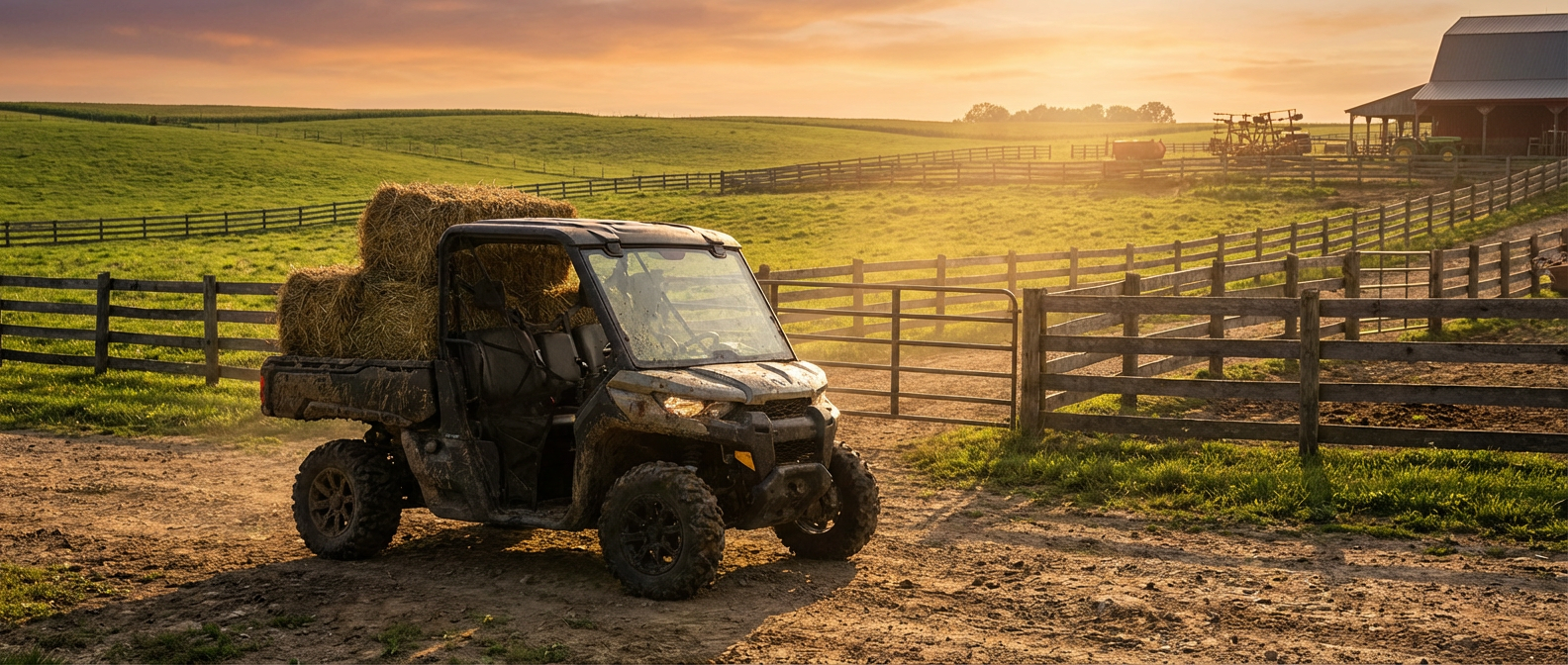
The farm truck—that legendary workhorse that hauled hay, moved tools, transported equipment, and served as an extension of the farmhouse—is increasingly sharing the driveway with an unexpected partner: the modern work-focused UTV. What began as a recreational novelty has evolved into legitimate farm equipment that's replacing traditional trucks on many operations.
The shift toward UTVs represents a fundamental change in how modern farmers and ranchers approach their work. A UTV costs a fraction of a new truck, requires less fuel, fits into spaces trucks cannot navigate, and provides the operator with an open-air experience that many prefer for the flexibility it offers. More importantly, a properly selected UTV can handle the vast majority of daily farm tasks with capabilities that older truck-based approaches cannot match.
This comprehensive guide covers everything you need to know about selecting, configuring, and maintaining a UTV for serious ranch and farm work in 2026.
The numbers tell a compelling story. A quality work-focused UTV costs between $10,000 and $20,000 new, compared to $35,000-50,000+ for a new truck. Used UTVs in the work segment run $6,000-12,000, a fraction of used truck pricing. For operations where capital is perpetually stretched, this difference is substantial.
Beyond cost, UTVs offer operational advantages that trucks simply cannot match. A UTV fits through farm gates designed when vehicles were narrower. The open-frame design allows quick access to loading areas and implements. The tight turning radius enables work in confined spaces—orchards, vineyards, and farm yards where trucks are impractical. For operations that include some recreational use (weekend hunting, trail riding with family), a work UTV serves dual purposes.
The modern work UTV features improvements that the early recreational models lacked: increased payload capacity (1,500-2,000 lbs in mid-size models), genuine towing capacity (3,000-5,000 lbs for utility implements), dump bed capability for hauling loose materials, PTO (Power Take-Off) shafts for running implements, and severe-duty suspension designed for consistent work rather than occasional recreation.
Not all UTVs are created equal. A machine optimized for high-speed desert recreation will disappoint as a farm machine, just as a true work UTV won't excite someone seeking weekend thrills. Understanding the differences ensures you invest in the right tool.
Work UTVs feature:
Recreational UTVs typically offer:
This distinction matters significantly. Regularly overloading a recreational UTV's suspension and frame accelerates wear and increases failure risk. Conversely, a work UTV's stiffer suspension and rugged build feel harsh on the trail compared to a true sport machine.
Work UTVs provide:
Recreational UTVs often feature:
For farm work, the dump capability alone justifies selecting a work-focused machine. The ability to haul rocks, sand, or gravel and deposit it with a hydraulic lift saves immense time and physical effort.
Farm work often requires precise, low-speed control while carrying heavy loads or towing through rough terrain. This is where work-focused machines distinguish themselves.
Work-Focused Design: Lower gear ratios that prioritize pulling power and control over top-end speed. A CVT-equipped work UTV typically maxes out around 35-40 mph while delivering maximum torque at very low speeds. Manual machines offer low-range gearing that can reduce speed to walking pace while maintaining full engine power.
Recreational Focus: Higher final drive ratios enabling higher top speeds (45-55+ mph) with less low-end pulling power.
For farm work, the ability to move at 5 mph while pulling a cultivator or hauling a load is far more valuable than the ability to achieve 50+ mph.
PTO (Power Take-Off) shafts transfer engine power to implements—a feature essential for serious farm work but entirely absent from recreational machines.
Work UTVs feature:
Recreational UTVs lack PTO capability entirely, limiting them to implementing with trailed (towed) equipment rather than powered implements.
The engine choice represents perhaps the most important decision in selecting your work UTV. Each option offers distinct advantages and challenges in farm environments.
Advantages:
Disadvantages:
Best For: Smaller operations with lighter duty cycles, operations where capital preservation is paramount, farm work that's seasonal rather than daily, and ranches where quiet operation is valued.
Advantages:
Disadvantages:
Best For: High-usage operations where the machine runs 4+ hours daily, operations emphasizing longevity and long-term value, heavy-duty applications with consistent towing, and ranches prioritizing fuel efficiency.
The math on diesel often favors total cost of ownership despite higher purchase price. A diesel UTV operating 1,000+ hours annually recovers the purchase premium through fuel savings alone while lasting significantly longer.
As of 2026, electric UTVs remain relatively rare but are emerging as legitimate options for specific applications:
The Polaris RANGER XP Kinetic represents the primary electric offering in the UTV market:
Advantages:
Disadvantages:
Best For: Operations within 30-mile radius of home base, operations emphasizing low operating costs, work primarily at a single location (equipment repair, yard maintenance, material handling), and farms requiring zero-emissions work (organic operations, special certifications).
Electric UTVs excel for concentrated, farm-based work but struggle with extended-range operations or serious hunting trips. They're optimal for the operation that already has a truck for distant travel but needs a capable yard and nearby-area work vehicle.
The traditional UTV design features two seats in tandem. Modern options now include crew cab configurations that increase seating to three or four riders.
Advantages:
Disadvantages:
Best For: Single-operator work-focused operations, ranches with existing transportation for employees, and situations where every pound of weight matters.
Advantages:
Disadvantages:
Best For: Operations with multiple regular riders, ranches emphasizing lifestyle use alongside work, and situations where the capability to transport workers justifies the weight penalty.
The trend in 2026 favors crew cab models for general-purpose ranch UTVs. The modest cost premium and minor efficiency trade-off seem acceptable to most buyers who value the flexibility of carrying multiple passengers.
The bed is where work happens on a farm. Selecting the right bed configuration dramatically impacts your machine's utility.
Hydraulic Dump Beds (standard on modern work UTVs):
Manual Tilt Beds (less common, found on older models or basic configurations):
For any serious farm work, hydraulic dump is non-negotiable. The time and effort saved justifies the cost premium within a single season.
Standard steel beds rust, corrode, and deteriorate quickly under farm conditions. Protective bed liners extend bed life significantly:
Rubber Coating: Factory-applied rubber coating (offered by Polaris, Can-Am, and others) provides corrosion protection and prevents materials from sticking. Excellent value, though needs occasional inspection for damage.
Composite/Composite Liners: Ultra-durable composite materials resist damage from sharp rocks, shovels, and abrasive loads. Most expensive option ($800-1,500) but longest lifespan.
Aftermarket Spray Liners: DIY or professional spray-on polyurethane or epoxy liners cost $400-800 and provide good protection. Quality varies with applicator expertise.
At minimum, ensure your bed includes some corrosion protection. Bare steel beds deteriorate visibly within a single season of regular use.
Farm work demands secure cargo containment. Quality tie-down systems prevent load shifting and loss.
Factory Systems: Work-focused UTVs feature integrated tie-down points along bed rails, typically spaced every 6-12 inches. Look for stainless or powder-coated points that resist corrosion.
Quick-Release vs. Fixed: Quick-release points allow rapid attachment of cargo management systems. Fixed points are simpler but less flexible.
Bed Rails: Full-height bed rails prevent lateral shift and enable creation of taller cargo containers. Short half-rails offer minimal containment.
For farm work, maximize tie-down points and ensure full-height rails if possible.
Stock beds max out around 36-40 cubic feet of volume. Bed extenders add 12-18 inches to length, increasing capacity by 40%+.
Removable Extenders: Fold down or bolt on as needed, useful if you vary load types frequently.
Permanent Extenders: Integrated extenders are simpler but less flexible.
Quality aftermarket extenders cost $300-600 and provide enormous utility gains. If your operation regularly hauls multiple loads, this is worthwhile.
A UTV's towing capacity determines what implements it can safely operate. Understand both the rating and the realistic capability.
Manufacturers' Ratings: The published towing capacity represents pulling power in ideal conditions (flat terrain, light load). Actual farm conditions—rough terrain, soft ground, hill pulling—reduce effective capacity.
Realistic Operational Capacity: Subtract 25-30% from the published rating for real-world farm conditions. A 5,000 lb-rated machine realistically pulls 3,500-3,750 lbs on typical terrain.
Light Implements (under 1,500 lbs, like spreaders or small cultivators): Even basic UTVs handle these adequately.
Medium Implements (1,500-3,000 lbs, like hay wagons or larger tillers): Mid-size UTVs with 4,000+ lb ratings work well.
Heavy Implements (3,000-5,000 lbs, like manure spreaders or large balers): Full-size work UTVs with 5,000+ lb ratings and adequate horsepower are essential.
Very Heavy Implements (5,000+ lbs): These require dedicated tractors. No standard UTV should attempt them.
Consider your implement collection when selecting your UTV. If your heaviest implement weighs 3,500 lbs, a 5,000 lb-rated machine provides adequate safety margin. If you plan adding heavier equipment, choose a machine with capacity beyond your current needs.
Tires are your first contact with work surfaces. The right tires dramatically improve capability and efficiency.
Best For: Operations mixing paved road access with varied terrain.
Characteristics: Balanced tread pattern works on pavement, gravel, and moderate off-road terrain. Highway-appropriate speeds and minimal vibration on pavement.
Drawbacks: Compromise in specialized terrain—not ideal in extreme mud or rocky terrain.
Cost: $150-300 per tire.
Best For: Operations emphasizing soft-ground and muddy-terrain capability.
Characteristics: Aggressive tread pattern evacuates mud effectively. Deep lugs provide grip in soft terrain.
Drawbacks: Loud on pavement, harsh ride quality, poor pavement traction.
Cost: $250-400+ per tire.
Best For: Operations prioritizing grass and yard preservation.
Characteristics: Low-pressure tires with minimal tread designed to distribute weight over wide area, minimizing soil compaction and turf damage.
Drawbacks: Unsuitable for rocky terrain or significant mud. Low speed capability.
Cost: $100-200 per tire.
Farm work often benefits from reduced tire pressure (for traction and flotation) compared to recreational use. Lower pressure:
Run 6-8 PSI lower than recreational recommendations for heavy pulling. Monitor pressure regularly—farm work and rough terrain accelerate pressure loss.
Farm work doesn't stop when weather arrives. Cab and roof options determine year-round operability and operator comfort.
Advantages:
Disadvantages:
Best For: Operations emphasizing comfort and year-round work, cold-climate ranches, and extended-work-hour operations.
Advantages:
Disadvantages:
Best For: Operations needing seasonal protection but prioritizing visibility, those balancing comfort and functionality, and ranches with moderate weather variation.
Advantages:
Disadvantages:
Best For: Warm-climate operations, summer-only use, and work emphasizing maneuverability and accessibility.
Hitch Receivers: A properly rated hitch (Class II minimum for work UTVs) is mandatory. Verify hitch attachment points are reinforced for your towing loads.
Tool Racks: Wall-mounted cargo boxes or tool racks keep hand tools, repair supplies, and implements organized and accessible. Budget $300-800 for quality racks.
Tie-Down Systems: Bed rail covers with integrated tie-down points ($200-400) improve organization and security.
Headlights and Work Lights: Stock headlights are adequate for visibility, but auxiliary LED work lights ($400-800) dramatically improve visibility during dawn, dusk, and night work.
Manual or Electric Spreaders: For granular material application (seed, fertilizer, salt), PTO-driven or electric spreaders mount in the bed. Expect $800-2,500 for quality spreaders.
Bluetooth Audio System: Water-resistant speakers ($300-600) improve the work experience during solo operations.
GPS and Mapping: Agricultural GPS systems ($2,000-5,000+) enable precision spraying, tilling, and harvesting. Premium systems include field mapping and yield tracking.
Auxiliary Fuel Tanks: Expandable fuel capacity ($500-1,000) extends range for large-acreage operations.
Heavy-Duty Winches: If you regularly work in situations requiring vehicle recovery, a 3,000-5,000 lb winch ($800-2,000) provides safety and convenience.
The 2026 farm UTV market features excellent options across price ranges:
Polaris RANGER 500 Crew: Two-cylinder gasoline, manual dump bed, suitable for light-to-moderate work. Excellent entry-point machine for small operations.
Honda Pioneer 520: Compact, lightweight gasoline UTV, strong brand support and parts availability. Best for minimal-footprint operations.
CFMoto UForce 500: Competitive pricing with surprising capability. Growing parts availability and dealer network.
Used Models (3-5 years old): Excellent value if sourced carefully. Inspect mechanical condition and history thoroughly.
Polaris RANGER 1000 Crew: The segment leader, excellent capability across work and recreation, proven reliability, strong resale value.
Can-Am Defender Max HD8: Superior towing and payload, excellent traction systems, strong dealer network.
Yamaha Wolverine RMAX2 1000: Balanced capability, excellent comfort and ride quality, growing work-focused accessory ecosystem.
John Deere Gator XUV865M: Traditional brand, excellent dealer support in agricultural regions, purpose-built work focus.
Polaris RANGER 1000 Diesel Crew: Best-in-class fuel economy, superior torque, proven long-term reliability in work environments.
Can-Am Defender Max DPS Cab: Excellent crew capacity, strong pulling power, full-featured cab options.
Kioti UTV: Diesel option at competitive price, growing market presence.
Polaris RANGER XP Kinetic: Electric option for specialized applications, zero emissions, lowest per-mile operating cost.
Choosing your work UTV requires honest assessment of your operation's needs:
Operating Hours: Machines seeing 4+ hours daily demand superior durability. Diesel investment often makes economic sense. Machines running 1-2 hours daily function adequately in gasoline models.
Terrain Type: Rocky terrain demands more suspension durability than flat fields. Muddy terrain necessitates specific tire selection. Sandy terrain benefits from lower gear ratios.
Implement Weight: Your heaviest implement determines towing capacity requirements. Select machines with 1,000-1,500 lb safety margin above your maximum expected load.
Climate Conditions: Cold regions benefit from diesel's superior cold-starting capability (with modern glow plugs). Extremely hot regions may favor gasoline's better high-altitude performance.
Budget Reality: Honest assessment of available capital determines whether you prioritize purchase price (gasoline models, two-seat configurations) or total cost of ownership (diesel, crew cab investment).
Existing Equipment: Compatibility with your existing hitch systems, PTO implements, and accessory infrastructure should influence machine selection.
Work UTVs see far more intensive use than recreational machines. This demands rigorous maintenance:
Every 50 Hours or Monthly:
Every 250 Hours or Quarterly:
Every 500 Hours or Annually:
Every 1,000+ Hours or as Needed:
Before Heavy Work Season: Full inspection, fluid changes, and accessory preparation ensure peak reliability.
End of Season: Thorough cleaning, fluid fill-up (prevention of corrosion), and battery disconnect if storing long-term.
Purchasing used work UTVs can offer exceptional value if you inspect carefully:
Hour Meter/Service History: Verify actual hours if available. Service records prove maintenance compliance. Machines with documented service histories command premiums—pay it.
Fluid Condition: Old, dark engine oil indicates poor maintenance. Coolant should be clear (not rusty). Hydraulic fluid should be clean (not cloudy). Poor fluid condition suggests neglected maintenance.
Wear Indicators: Examine tire wear patterns (inside vs. outside, high vs. low spots). Check brake pad thickness. Look for excessive play in steering and suspension.
Frame and Welds: Look for cracked or repaired welds (indicated by discoloration or ground marks). Frame cracks suggest accident history or overuse beyond design parameters.
Rust and Corrosion: Surface rust is cosmetic. Structural rust on frame or A-arms is cause for concern. Check underneath for rust severity.
Fluid Leaks: Minor seepage is normal. Active leaks from engine, transmission, or hydraulic systems indicate repairs needed.
Engine Start and Operation: Cold starts should be relatively quick. Engine should idle smoothly and respond progressively to throttle. Listen for odd noises—knocking suggests internal damage.
Transmission/Gearbox: Test all gears. Shifting should be smooth. Jerky engagement or difficulty finding neutral suggests maintenance or replacement needed.
Brakes: Test braking from various speeds. Brakes should feel firm and responsive. Soft or spongy brakes indicate system service needed.
Well-maintained 3-5 year old work UTVs typically retain 55-70% of original purchase price. Machines with documented service history, under 1,000 hours, and good cosmetic condition command higher percentages. Heavily used machines or those lacking service records drop to 40-50% of original price.
Work UTVs typically hold value better than recreational machines. This is because actual farmers and ranchers use these machines and understand their value. A well-maintained work UTV remains useful for 10+ years, creating steady used market demand.
Diesel models typically command premiums in the used market due to their reputation for longevity. Crew cab models have broader appeal than two-seat models. Machines with factory cabs are more desirable than open-frame machines.
This resale value factor justifies investing in quality machines and maintaining them properly. A $20,000 diesel UTV properly maintained might retain $12,000-14,000 value after five years of regular work use—far better retention than many consumer goods.
The 2026 farm and ranch UTV market offers unprecedented choice and capability. Modern work-focused machines handle tasks that would have required multiple trucks and equipment just a decade ago. The investment in the right machine pays dividends immediately in efficiency, capability, and versatility.
Take time to evaluate your actual operation's needs rather than features that sound impressive but don't serve your work. Start with a conservative machine—a well-selected UTV can work effectively for 10-15 years. Invest in quality accessories that directly improve your operation. Maintain religiously. And finally, recognize that your work UTV is an investment that, when treated properly, will serve your operation reliably for years to come.
Powersports Writer & Enthusiast
Published
March 24, 2026
Reading Time
20 min read